| Size: |
10.5" |
| Materials: |
Copper Alloy with 24 Karat Fully Gold Gilded. |
| Crafted By: |
Master artisan from Patan, Nepal. |
| Made In: |
Nepal. |
| Time to Ship: |
24 Hours |
| Availability: |
World wide delivery within 3 – 5 business days. |
| Insurance: |
Yes. |
| Speciality: |
Copper Alloy with 24 Karat Fully Gold Gilded which has very fine excellently carved details. |
| |
|
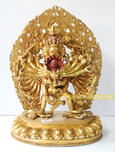
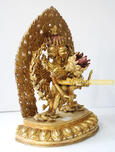
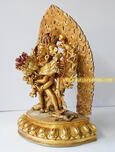
Fully Gold Gilded 10.5” Chakrasamvara with Vajravarahi is made from Copper with 24 Karat Gold has very fine and excellently carved which is crafted by the experienced artisan from Patan, Nepal who has been in this business from generations.
Chakrasamvara and Vajravarahi
--------------------------------------------------------------------------------------------------------------
Chakrasamvara and his consort Vajravarahi embrace in a sexual union that symbolizes enlightenment through the blissful union of compassion and wisdom. This male-female union is known as the Yab-Yum form. In contrast, Chakrasamvara stands on minor deities representing maleness and femaleness. The deity under his right foot is Kalaratri, the Night of Time, who represents nirvana. Under the left is Bhairava, the Terrifier, who represents samsara (Rhie 278). Chakrasamvara has transcended these extremes, so he stands atop them in the warrior’s pose, with the left knee bent and the right extended at an angle. Chakrasamvara is depicted in his four-headed, twelve-armed form. He wears a crown featuring sixteen spires, including a larger spire over each of his faces. The rim of his crown is set with turquoise, and its center, atop his coiled hair, features a small red stone, probably coral. He also wears garlands of skulls about his neck and waist, one of which hangs between the two figures. His expression is intense. Two eyes look down at his consort, and the third, which always sees reality directly, looks upward. Each of his 12 arms holds a ritual object, which symbolize the “experience of overcoming the specific obstructions inherent in self-centered consciousness.” In the hands that embrace his consort, Vajravarahi, Chakrasamvara holds the vajra and bell in the HUM-sound gesture. They symbolize the union of wisdom and skillful means, and the destruction and transmutation of egotistic processes. In his other left hands, from top to bottom, he holds the Khatvanga staff, indicating the “blissful thought of enlightenment;” the skull cup, showing that he “has cut away the discrimination between existence and nonexistence;” the vajra lasso, which binds beings to wisdom from life to life; and the severed four-faced head of Brahma, which represents his triumph over the temptation to become a god. In his right hands, he holds the damaru drum, to symbolize his joyous voice; the vajra chopper, which cuts off “the six defects, pride and the rest”; the ax, which “cuts off birth and death at the roots;” and the trident, showing that he has “overcome the evil of the threefold world (Rhie 279).” In other representations, Chakrasamvara typically holds the flayed skin of the elephant of ignorance behind his back. This is another symbol of the obstacles to enlightenment which he has overcome. Here, however, he holds another object, which is difficult to identify, in two of his hands. It may represent a form of the thighbone trumpet. The Buddhist worshipper, by meditating on the figure and the objects, applies the deity’s triumphs to his own mental state in an effort to achieve enlightenment.
Chakrasamvara’s consort, Vajravarahi, is herself an important deity symbolizing wisdom. Here, she stretches her left leg to rest her foot on Chakrasamvara’s right foot. Her right leg is folded over his thigh. She wears a small crown and holds a skull cup and a vajra chopper, both behind Chakrasamvara. She also wears an ornate girdle and has bracelets of human bone on her wrists and ankles.
In this sculpture, Chakrasamvara and his consort Vajravarahi embrace in a sexual union that symbolizes enlightenment through the blissful union of compassion and wisdom. This male-female union is known as the yab-yum form. In contrast, Chakrasamvara stands on minor deities representing maleness and femaleness. The deity under his right foot is Kalaratri, the Night of Time, who represents nirvana. Under the left is Bhairava, the Terrifier, who represents samsara. Chakrasamvara has transcended these extremes, so he stands atop them in the warrior’s pose, with the left knee bent and the right extended at an angle. Chakrasamvara is depicted in his four-headed, twelve-armed form. |
| |
|
|