| Size: |
9.25” |
| Materials: |
Copper Alloy with 24 Karat Fully Gold Gilded. |
| Crafted By: |
Master artisan from Patan, Nepal. |
| Made In: |
Nepal. |
| Time to Ship: |
24 Hours |
| Availability: |
World wide delivery within 3 – 5 business days. |
| Insurance: |
Yes. |
| Speciality: |
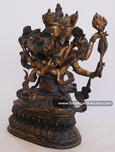
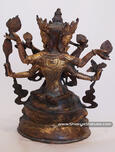
9.25” GuhyaSamaja Statue is beautifully carved Fully Gold Gilded decorated with colorful stones which is crafted by the experienced artisans of Patan, Nepal. |
| |
|
This 9.25” Fully Gold Gilded GuhyaSamaja Sculpture is made from Copper Alloy with Fully Gold Gilded Statue or Sculpture which is crafted by our experienced artisan of Patan, Nepal who has been in this business from generations.
GuhyaSamaja – King of Tantra
--------------------------------------------------------------------------------------------------------------
Guhyasamaja means "Secret Union" or "Assembly of the Secret” Ones (In Tibetan Sangwa-dupa) Guhyasamaja is also known as "King of Tantras". In Tibet, Guhyasamaja is particularly favored by the Geluk Order, most likely for the antiquity of his texts. Translated in the 8th century, the Guhyasamaja Tantra was one of the first Sanskrit works to be translated into Tibetan. One tradition has it that Shakyamuni Buddha himself proclaimed the tantra the morning after his enlightenment. Other traditions claimed tat Maitreya taught the tantra in the Tushita Heaven, and that the Indian scholar Asanga brought it to the human world in the 4th century. Like other deities of the Unexcelled Yoga tantra tradition, Guhyasamaja is associated with the Buddha Akshobhya. Many texts, including the Guhyasamaja Tantra itself, simply call him Akshobhya or Akshobhyavajara. Guhyasamaja is dark blue in color. Guhyasamaja has three faces: the central one is blue and fierce, the right face is peaceful white; and the left one is red. Guhyasamaja is considered Lord of the Diamond Body, Speech, and Mid of All the Thatagatas. Guhyasamaja gently holds his consort, Sparshavajra, in an intimate embrace. The goddess has six hands and three faces, and is "like her consort," in the words of an early ritual. Sparshvajra gazes upward in rapture, meeting Guhyasamaja´s downward glance. The goddess protects an energy and ferocity that contrasts with the serene countenance of her mate. Being "of the same nature," the divine pair possesses similar hand implements. The central pair of hands hold, right and left, a Vajra cepter and a bell, the upper pair, a wheel and a blazing jewel; the lower pair, a lotus and a sword. The Vajra cepter and the bell symbolize, among other things, the Vajra Buddha clan of Akshobhya. The wheel symbolizes the mirror wisdom clan of Vairochana, the lotus the discriminating wisdom clan of Amitabha, the jewel the equality wisdom clan of Ratnasambhava, and the sword the all – accomplishing wisdom clan of Amogasiddhi. Thus Guhyasamaja Buddha symbolically represents the union of all the Buddha clans. |
| |
|
|